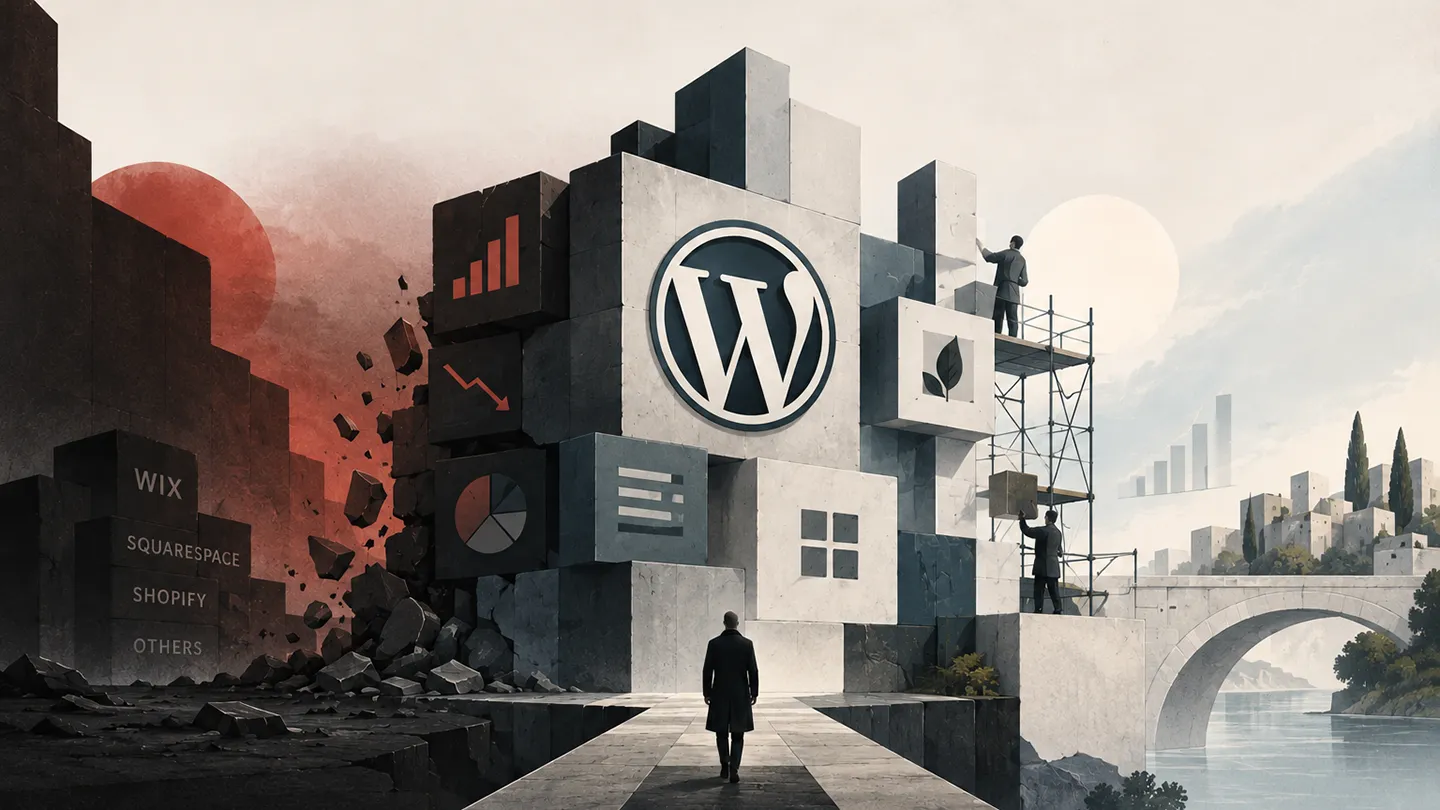
No. WordPress is not dying in 2026.
But the easy version of that answer — "WordPress still powers a huge part of the web, so everything is fine" — is no longer convincing either.
The market-share decline is now real enough to measure. According to W3Techs' current CMS data, WordPress is used by 40.7% of all websites and holds 58.9% of the known CMS market as of early September 2026. At the start of 2025, those figures were 43.6% and 62.0% respectively.
That is not the collapse of a platform. It is a meaningful change of direction for a product that spent more than a decade turning growth into an expectation.
Our view is that WordPress has entered a different phase: maturity, stronger competition, and forced reinvention. It is losing some of the jobs it used to win by default while remaining extraordinarily difficult to replace where flexibility, ownership, extensibility, publishing, or custom business logic matter.
Last researched: 7 September 2026. Market-share figures change frequently, so we link directly to the underlying data wherever possible.
The Short Version
Here is the position we think the data supports:
| Question | Our answer |
|---|---|
| Is WordPress dying? | No |
| Is WordPress losing market share? | Yes |
| Is the 2026 decline large enough to take seriously? | Yes |
| Is WordPress still the dominant CMS? | By a very large margin |
| Is WooCommerce under pressure from Shopify? | Yes |
| Is WordPress development slowing down? | No — Core is shipping significant changes |
| Is WordPress still the automatic choice for every website? | No |
| Is WordPress still a strong long-term platform? | Yes, for the right projects |
The important distinction is between decline and death. A platform can lose share while still remaining the largest player in its market, commercially important, technically active, and useful for millions of new projects.
That is where WordPress sits in 2026.
First, What Does the Market-Share Data Actually Say?
For this article we use W3Techs because it provides a consistent historical dataset and updates its reports daily. Its methodology currently covers well over 20 million relevant websites, excludes duplicate and content-less sites, treats subdomains as part of the same website, and tracks technologies at the website rather than individual-page level.
No web-technology tracker should be treated as a perfect census of the internet. Detection methods, samples, and definitions matter. What makes the W3Techs data useful here is the trend within the same dataset.
There are also two different percentages that are frequently mixed together:
- Usage means the percentage of all websites in the survey using WordPress.
- CMS market share means WordPress's share among websites where W3Techs detects a content management system.
Using W3Techs' historical usage data and historical CMS market-share data, the recent pattern looks like this:
| Date | WordPress share of all websites | WordPress share of known CMS market |
|---|---|---|
| January 2022 | 43.2% | 65.2% |
| January 2023 | 43.1% | 63.7% |
| January 2024 | 43.1% | 62.9% |
| January 2025 | 43.6% | 62.0% |
| January 2026 | 43.0% | 60.2% |
| September 2026 | 40.7% | 58.9% |
The story is clearer when you look across several years rather than one monthly movement.
WordPress effectively plateaued around 43% of the web from 2022 through 2025, while its share of the CMS market was already gradually shrinking. Then 2026 brought a faster decline in absolute usage: from 43.0% in January to 40.7% in September.
A 2.3 percentage-point decline in eight months is not something we would dismiss as statistical noise.
It also does not mean WordPress is disappearing.
WordPress Is Still Enormous Compared With Every Competitor
The same W3Techs dataset that shows WordPress shrinking also shows how far ahead it remains.
As of September 2026:
| Platform | Share of all websites | Share of known CMS market |
|---|---|---|
| WordPress | 40.7% | 58.9% |
| Shopify | 5.3% | 7.7% |
| Wix | 4.2% | 6.1% |
| Squarespace | 2.5% | 3.6% |
| Webflow | 0.8% | 1.2% |
WordPress still powers more than three times as many websites as Shopify, Wix, Squarespace, and Webflow combined in this dataset.
It is also not merely a long tail of forgotten blogs. W3Techs reports that WordPress represents 49.3% of websites with a known CMS in the top one million sites.
So "WordPress is dying" does not fit the installed-base reality. A dying technology does not normally control close to 59% of its category, roughly half of the known-CMS sites in the top million, and an ecosystem large enough to support entire hosting, agency, plugin, theme, security, and ecommerce industries.
The more useful question is why that lead is getting smaller.
The Most Important Warning Sign May Be WooCommerce, Not WordPress Core
Ecommerce is one of the clearest places where competitive pressure is visible.
W3Techs' ecommerce market data still puts WooCommerce first. As of September 2026, WooCommerce is detected on 8.1% of all websites and represents 48.1% of sites using an ecommerce system in the W3Techs survey. Shopify is second at 31.7% of the ecommerce market.
But the direction matters.
The W3Techs ecommerce trend shows:
| Date | WooCommerce ecommerce share | Shopify ecommerce share |
|---|---|---|
| September 2025 | 51.1% | 27.7% |
| January 2026 | 50.4% | 28.8% |
| September 2026 | 48.1% | 31.7% |
WooCommerce remains larger, but Shopify has gained four percentage points of ecommerce-system share in roughly a year while WooCommerce has lost three.
That makes sense as a competitive dynamic even without pretending every percentage point represents a direct migration from WooCommerce to Shopify.
Shopify is extremely good at selling a simple promise: the merchant gets hosting, checkout, payments, infrastructure, updates, and the core commerce platform from one vendor. WooCommerce gives the merchant far more architectural freedom, but that freedom also means more decisions, more dependencies, and more responsibility.
For a business owner who wants to start selling rather than manage a web stack, the SaaS proposition is powerful.
For businesses that need WordPress's content model, deep customization, ownership, unusual checkout logic, custom integrations, or a plugin ecosystem that can be modified at code level, WooCommerce remains difficult to replace. That is why we still recommend products from the ecosystem in our WooCommerce plugin guide.
But WooCommerce can no longer assume "WordPress plus ecommerce" wins automatically.
Why Is WordPress Losing Share?
There is no single dataset that can tell us exactly why WordPress has lost each fraction of a percentage point. Anyone presenting one cause as proven fact is going further than the evidence supports.
We think several pressures are working at the same time.
1. Simple websites have much better alternatives than they used to
A decade ago, WordPress often won because the alternatives were either too limited or too expensive.
That is no longer true.
For a brochure site, portfolio, restaurant site, one-person business, landing page, or simple marketing presence, products such as Wix, Squarespace, Webflow, Framer, Shopify, and newer AI-first builders can remove entire categories of decisions.
The customer may not need to think about:
- hosting
- PHP versions
- plugin compatibility
- backups
- caching
- security plugins
- theme updates
- SMTP
- database maintenance
WordPress can handle all of those things extremely well. The problem is that, for a simple site, the user increasingly asks why they should have to handle them at all.
This is probably the biggest structural change in the market: WordPress is being forced to justify its flexibility instead of receiving credit for it automatically.
2. The flexibility has a maintenance tax
The WordPress plugin directory now lists more than 71,000 free plugins. The official theme directory advertises more than 14,000 free themes.
That breadth is one of WordPress's greatest competitive advantages. It is also one of its hardest product problems.
A WordPress site is rarely just WordPress Core. A serious site may combine a theme, page builder, SEO suite, forms, ecommerce, payment gateways, analytics, security, caching, multilingual tools, custom code, and integrations from unrelated vendors.
When that stack is curated well, WordPress is remarkably capable.
When it is assembled badly, the result is exactly the stereotype that hurts the platform: slow admin screens, update anxiety, plugin conflicts, duplicate functionality, security problems, and a site nobody wants to touch.
Security data illustrates the distinction. Patchstack's State of WordPress Security in 2026 says 91% of the vulnerabilities it recorded for 2025 were in plugins and 9% were in themes, with only a handful in WordPress Core itself.
That does not mean "WordPress is insecure." It means the ecosystem is part of the security boundary, and owning a WordPress site means taking extension quality seriously.
3. WordPress has spent years rebuilding the editing experience in public
The block editor was the correct kind of problem for WordPress to attack: the old editor was not going to carry the platform through another decade of visual site building.
The transition has nevertheless been long and messy.
One useful signal is the official Classic Editor plugin, which still shows 8+ million active installations in 2026. That number should not be misread as eight million people rejecting Gutenberg — many legacy sites and plugin workflows simply require the old editor — but it demonstrates how much of the installed base still depends on pre-block workflows.
Meanwhile, some capabilities users expect from modern visual builders have taken years to arrive in Core.
WordPress 7.1, released in August 2026, finally brought responsive styling controls directly into the Site Editor, including configurable breakpoints for block themes. It also added richer collaboration Notes, a redesigned media editor, new Tabs and Playlist blocks, interactive states for buttons, and a more consistent iframed editing canvas.
Those are good improvements.
They are also evidence that WordPress is still closing UX gaps that commercial builders have been highly motivated to solve faster.
4. Governance became a product risk, even if it is not a product feature
The WordPress ecosystem also spent 2024 and 2025 dealing with an unusually public dispute between Automattic, Matt Mullenweg, and WP Engine. The conflict included litigation, restrictions around WordPress.org access, arguments over trademark use and contribution levels, and wider debate about governance of infrastructure that much of the ecosystem depends on.
It would be irresponsible to claim that this dispute caused the 2026 market-share decline. The timeline alone cannot prove that.
It is still reasonable to say that governance confidence matters when agencies, hosts, plugin companies, investors, and enterprise buyers make long-term platform decisions.
Automattic also reduced its workforce by approximately 16% in April 2025 and temporarily reduced or paused parts of its WordPress contribution before announcing a full return to Core contribution in May 2025.
The important distinction is that WordPress the open-source project is larger than Automattic, while Automattic is simultaneously influential enough that its decisions matter to the ecosystem. Both things can be true.
The Counterargument: WordPress Development Does Not Look Like a Dying Project
If market share were the only thing we examined, the article would be too pessimistic.
The software itself is moving quickly.
WordPress 7.1 shipped on 19 August 2026 with more than 1,500 enhancements and fixes, according to the official release announcement. More than 800 contributors participated, including over 170 first-time contributors.
The release added practical improvements users have wanted for years:
- responsive block styling without custom CSS
- custom breakpoints in block themes
- inline collaboration Notes with mentions
- browser-side image processing to reduce server load
- improved support for AVIF, HEIC, and HDR gain maps
- Tabs and Playlist blocks
- hover, focus, and active states in editor styling controls
- a more consistent post and site editing canvas
This is not maintenance-mode development.
More importantly, WordPress is trying to position itself for the next platform shift rather than merely polishing the CMS it already has.
AI Could Be a Threat to WordPress — or One of Its Best Opportunities
AI site generation is an obvious threat to the easiest part of the WordPress market.
If someone wants a five-page brochure site and an AI builder can generate the design, copy, forms, hosting, deployment, and future edits from a prompt, the value of manually assembling a conventional WordPress stack drops.
But AI also changes the value of open, programmable systems.
WordPress 7.0 explicitly started laying AI foundations in Core. Its provider-agnostic AI client and Abilities APIs are designed so plugins and external tools can discover and perform permission-controlled WordPress actions without every vendor inventing a separate integration layer.
WordPress 7.1 expanded that Abilities infrastructure for automation and AI-powered tooling.
At the same time, WordPress Playground has become substantially more capable. WordPress says 99% of the top 1,000 plugins could be installed and activated successfully in Playground testing after its 2025 improvements. The project now supports browser-based development, testing, demos, CLI workflows, and AI-agent tooling.
In March 2026, WordPress also introduced my.WordPress.net, which runs a persistent WordPress instance entirely in the browser and explicitly experiments with AI-assisted customization.
That direction matters.
A closed website builder can use AI to make its own feature set easier to access. WordPress can potentially let AI operate across an enormous open ecosystem of content, plugins, custom code, APIs, and business logic.
Whether WordPress executes that opportunity well is not guaranteed. But "WordPress is too old for the AI era" is already an outdated description of what the project is building.
WordPress's Biggest Advantage Is Also Why It Feels Old Sometimes
WordPress is more than 20 years old. That creates baggage.
It also creates compatibility, accumulated knowledge, integrations, hosting expertise, agency expertise, documentation, migration tools, APIs, plugins, and commercial products that younger platforms cannot manufacture quickly.
Mature infrastructure tends to look less exciting than a new product because it has to care about things new products can ignore.
A new site builder can redesign its interface around one opinionated workflow.
WordPress has to consider:
- millions of existing sites
- custom plugins written years ago
- backwards compatibility
- enterprise publishing workflows
- accessibility
- localization
- third-party themes and builders
- REST integrations
- WooCommerce stores
- multisite networks
- developers extending practically every layer of the system
That slows some forms of innovation.
It also means a business can build something unusually specific without waiting for a SaaS vendor to add the feature to its roadmap.
The tension is fundamental: WordPress's openness creates both its complexity and its defensibility.
Where We Would Still Choose WordPress in 2026
WordPress remains our default shortlist for projects where the site is expected to become a system rather than remain a set of pages.
We would strongly consider it for:
Content-heavy websites and publications
WordPress is still exceptionally good at structured content, editorial workflows, taxonomies, archives, SEO control, scheduled publishing, media, user roles, and years of accumulated content.
WooCommerce stores with custom requirements
If commerce is tightly connected to content, memberships, subscriptions, unusual product structures, custom checkout logic, ERP/CRM integrations, B2B workflows, or bespoke operational requirements, WooCommerce's extensibility remains a major advantage.
Membership, LMS, directory, and community projects
The plugin ecosystem can turn WordPress into products that would require much more custom development on a less extensible platform.
Businesses that care about portability and control
WordPress is open-source software. You can move hosts, access the database, change developers, modify plugins, replace infrastructure, export content, or run the software yourself.
That flexibility has real value once a website becomes business-critical.
Custom integrations
WordPress is unusually practical when the project needs to connect to systems that do not fit a website builder's standard app marketplace. PHP hooks, REST APIs, WP-CLI, scheduled jobs, custom tables, and a vast developer ecosystem make unusual requirements normal rather than exceptional.
Where We Would Not Automatically Choose WordPress
The platform's market-share decline becomes easier to understand when we look at the projects where WordPress no longer has an obvious advantage.
| Project | What we would evaluate first |
|---|---|
| Five-page brochure site with no special requirements | Hosted/AI site builders alongside WordPress |
| Merchant who wants the simplest managed ecommerce operation | Shopify alongside WooCommerce |
| Design-led marketing site with a team that wants minimal maintenance | Webflow and similar managed builders alongside WordPress |
| Temporary campaign or landing page | A lightweight hosted builder may be enough |
| Product whose main interface is a complex application rather than content | A custom application stack may make more sense |
| Content-rich, extensible, integration-heavy site | WordPress remains one of the strongest options |
Choosing something else for the first five cases is not evidence that WordPress has failed.
It is evidence that the web platform market is healthier and more specialized than it was when WordPress could credibly be recommended for almost everything.
Is WordPress Still Worth Learning in 2026?
Yes — with one qualification.
We would not recommend learning only WordPress.
A developer who understands PHP, JavaScript, CSS, databases, HTTP, APIs, performance, security, Git, and modern deployment practices can use WordPress as one extremely valuable platform in a broader toolkit.
Someone who learns only how to click through a specific theme or page builder is much more exposed to changes in the market.
The same applies to agencies. "We build WordPress websites" is becoming a weaker proposition than "we solve web and commerce problems, and WordPress is one of the systems we know deeply."
WordPress expertise remains commercially useful precisely because the installed base is so large and because complex WordPress sites still need people who understand what is happening below the page builder.
Is WooCommerce Dying?
No, but the competitive warning is stronger than it is for WordPress publishing.
WooCommerce still leads W3Techs' ecommerce-system dataset at 48.1% market share, compared with Shopify at 31.7%.
The uncomfortable part is the trajectory: WooCommerce was at 51.1% a year earlier while Shopify was at 27.7%.
For WooCommerce, the next few years are likely to be less about proving that it can do almost anything and more about making common commerce workflows easier without sacrificing the extensibility that makes the platform valuable.
That is a product challenge, not an obituary.
Will AI Replace WordPress?
AI will probably replace a meaningful amount of manual website assembly.
That is different from replacing the CMS.
If AI can generate a theme, configure plugins, write integration code, build blocks, populate content, test the result, and make changes through standardized WordPress abilities, WordPress may become less visible to the person creating the site while remaining the system underneath it.
That is one reason the work around the AI client, Abilities API, Playground, and browser-based WordPress is strategically important.
The risk is that proprietary builders deliver that experience faster and more coherently.
The opportunity is that WordPress can offer something those systems cannot easily copy: AI operating on an open platform that the site owner can inspect, extend, move, and control.
Our Verdict: Decline, Maturity, or Reinvention?
All three, but not in equal measure.
There is decline. WordPress has fallen from 43.6% of all websites at the beginning of 2025 to 40.7% in September 2026 in W3Techs' dataset. Its CMS market share has fallen below 59%. WooCommerce is giving up ecommerce share while Shopify gains it. Those numbers deserve attention.
There is maturity. WordPress is a 20-plus-year-old platform with an enormous installed base. Markets this large do not behave like startup growth charts forever. Some of the easiest websites are moving to simpler specialized products, and that is rational.
And there is reinvention. WordPress 7.0 and 7.1 are not the releases of a project waiting to die. Core is improving the visual editing experience, collaboration, media handling, responsive design, developer APIs, automation, and AI infrastructure while projects such as Playground experiment with completely different ways to run and develop WordPress.
Our conclusion is therefore not "WordPress is fine, ignore the numbers."
It is this:
WordPress is losing its status as the automatic answer to every website project. That may be healthy.
The platform now has to win projects on the things it is genuinely better at: extensibility, ownership, content, ecommerce flexibility, integrations, ecosystem depth, and the ability to become something more specialized than a website builder allows.
If WordPress can reduce the complexity tax while keeping those advantages, a smaller percentage of a much larger web can still represent an extraordinarily strong platform.
If it cannot, the decline will continue.
Either way, 40.7% of the web is not death. It is a very large incumbent being forced to compete again.